
Pest Control Customer Retention Automation: Proven Sequences That Stop Revenue Leaking
Pest control businesses lose 20–30% of recurring customers to simple oversight. When quarterly treatments aren’t proactively scheduled, customers forget, move on to a competitor, or assume they no longer need service. Pest control customer retention automation is the systematic answer to this problem: a set of automated sequences that reach out before renewal deadlines, catch customers before they drift, and recover lapsed accounts without any manual effort from the business owner or admin.
This guide covers the pest control customer retention automation sequences that actually work, the tools that implement them, and how to prioritise what to build first.
Why Manual Renewal Follow-Up Fails at Scale
Manual renewal tracking works at twenty customers. At two hundred, it fails — not because the owner stops caring, but because the cognitive load of tracking dozens of treatment dates simultaneously across different service types and customer categories is simply beyond what anyone manages reliably in parallel with actually running the business.
NPMA research on pest control customer behaviour consistently shows that businesses with systematic renewal follow-up retain significantly more recurring customers than those relying on inbound rebooking. The difference isn’t customer satisfaction — it’s whether someone or something reaches out before the customer thinks to look elsewhere. Pest control customer retention automation bridges that gap at scale.
The Four Automations Every Pest Control Business Needs
1. The Renewal Reminder Sequence
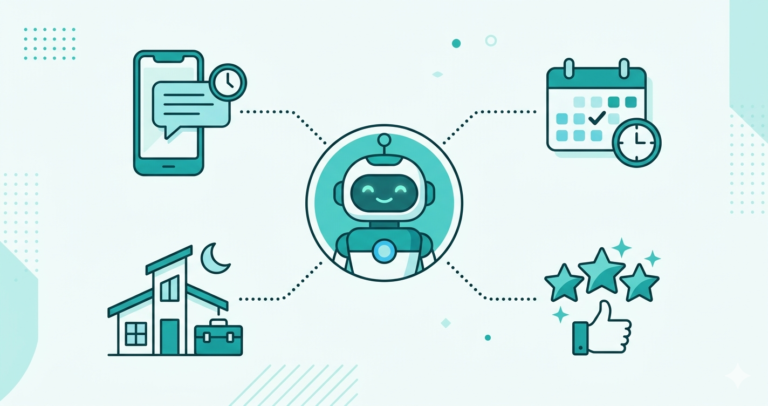
The highest-ROI pest control customer retention automation is a renewal reminder sequence triggered by each customer’s treatment anniversary date. A three-touch approach works well: thirty days before the next treatment is due, fourteen days out, and seven days out. Each message includes the booking link, a brief reminder of what was done last time, and a clear call to confirm the appointment.
The sequence doesn’t need to be elaborate — a short, specific message referencing the customer’s actual service history performs better than a generic reminder. Customers who feel remembered and looked after renew at far higher rates than those who receive a form letter.
2. The Post-Service Follow-Up
A message sent two to three days after a completed treatment — asking how things went and whether any pest activity was noticed — accomplishes three things simultaneously: it identifies dissatisfied customers before they quietly churn, it prompts satisfied customers to leave a Google review (which drives future business), and it keeps the company’s name top-of-mind between services.
For pest control customer retention automation specifically, the review request is worth special attention. Google reviews are one of the primary drivers of new residential customer enquiries in this trade, and asking at the moment of post-service relief converts far better than asking weeks later or not at all.
3. The Lapsed Customer Re-Engagement Campaign
A customer who completed a treatment twelve to eighteen months ago and hasn’t rebooked is a strong candidate for re-engagement — particularly ahead of seasonally active pest periods. An automated message sent in late February (before spring pest season), early summer, and early autumn reaches lapsed customers at the moments they’re most likely to be thinking about pest control anyway.
Re-engagement for lapsed customers doesn’t need to be pushy. A simple message referencing what was done last time and noting that the season is about to bring the same issues often prompts rebooking without needing a discount or hard sell.
4. The No-Response Escalation
When customers don’t respond to automated reminders, a meaningful share simply missed the email or forgot to reply — they haven’t cancelled. The escalation sequence for non-responders catches these before they’re written off: if no response by five days before the scheduled service, an SMS goes out; if still nothing by three days before, the record is flagged for a manual phone call.
This layered approach recovers renewals that single-touch automation misses, without requiring anyone to manually track every unanswered message.
The Tools That Implement Pest Control Customer Retention Automation
1. Systeme.io — Best for Small Operations at Zero Cost
Systeme.io is the strongest starting point for pest control customer retention automation for businesses with one to five technicians. Free for up to 2,000 contacts, it covers email automation sequences, contact tagging by service type and renewal status, basic pipeline tracking, and calendar scheduling — everything needed to run the four sequences above without a monthly bill.
The limitation is that it’s a general marketing platform rather than a field service tool — it won’t handle route optimisation or on-site invoicing. But for the renewal and re-engagement side of pest control customer retention automation, it covers what matters most at zero cost.
🔔 Best free tool for pest control customer retention automation
Renewal reminders, post-service follow-up, and re-engagement campaigns — free for up to 2,000 contacts. No credit card required.
2. Zoho CRM — Best for Growing Teams
Zoho CRM is the best platform for pest control customer retention automation at team scale. Free for up to three users with workflow automation on the free tier, it handles multi-user renewal management — assigning renewal follow-ups to specific team members, automating campaigns across the full customer base, and maintaining shared property records accessible to all technicians.
Zoho’s native connection to Zoho Bookings allows customers to self-schedule renewal appointments, which reduces inbound call volume significantly. Zoho’s recurring service case studies document a number of businesses that improved renewal rates by fifteen to twenty percentage points simply by implementing systematic automated follow-up at the team level.
✓ Best for pest control teams of 2–10 technicians
Free for up to 3 users with workflow automation, multi-user renewal management, and self-booking integration.
3. Pipedrive — Best for Commercial Account Pipeline
Pipedrive is the best tool for pest control customer retention automation on the commercial account side — where the renewal conversation is more like a sales process than a simple reminder. Its visual pipeline tracks every commercial account renewal from initial contact through to confirmed service agreement, and its deal rotting alerts flag any account that hasn’t had contact in a set number of days.
For pest control businesses managing a mix of quick residential renewals and longer commercial account cycles, Pipedrive handles the commercial pipeline side while Systeme.io or Zoho handles residential automation. At $14/user/month, it earns its cost by preventing commercial renewal conversations from going cold through inaction.
📊 Best for commercial pest control renewal pipeline
Visual pipeline and deal rotting alerts keep every commercial renewal visible. From $14/user/month.
What to Build First
The most common mistake in pest control customer retention automation is trying to build everything before going live. The better approach: start with the renewal reminder sequence and the post-service follow-up. Configure those, run them for thirty days, and measure the improvement in renewal rates before adding lapsed customer campaigns or commercial pipeline automation.
Most pest control businesses that implement even these two automations see renewal rate improvements of ten to fifteen percentage points in the first ninety days — which, for a business with 200 recurring customers at $300 average annual value, translates directly to $6,000–$9,000 in recovered annual revenue.
Personalisation Makes Automation Work Better
Automated doesn’t mean impersonal. The pest control customer retention automation sequences that convert best reference something specific about the customer’s actual service history — the pest type treated last time, the technician’s name, the specific property address. A message that says “Your quarterly protection against the carpenter ants we treated last spring is coming up” outperforms “Your quarterly service is scheduled” on every metric.
All three platforms above support personalisation tokens that pull customer data into email and SMS messages. The time investment in setting up personalised templates pays for itself in measurably higher response rates.
Frequently Asked Questions
What’s the best timing for pest control customer retention automation reminders?
Start thirty days before the treatment anniversary date, with follow-up at fourteen and seven days out. For non-responders, add an SMS at five days and a manual call flag at three days. This layered approach catches customers at multiple moments without being aggressive.
Can pest control customer retention automation replace a dedicated field service platform?
For the renewal and customer relationship side: yes, the platforms above cover it well. For route optimisation, chemical usage logging, and on-site invoicing: no, a field service tool handles those better. Most growing pest control businesses use a CRM for the marketing and renewal side and a field service tool for operations — they’re solving different problems.
How much does pest control customer retention automation improve renewal rates?
Businesses moving from manual or no follow-up to systematic automation typically see renewal rates improve from 70–75% to 85–90%. For a 300-customer residential base at $250 average annual value, that difference is $11,250–$15,000 in annual revenue — for automation that, once configured, costs nothing per renewal in additional time or labour.
Compare Your Options
Related reading: our guides on best CRM for pest control companies, CRM for recurring revenue service businesses, and CRM missed call automation.
Affiliate Disclosure: This article contains affiliate links. If you click through and make a purchase, we may earn a commission at no additional cost to you. We only recommend products we believe add real value to our readers.