How to Manage a Roofing Sales Pipeline (From First Call to Signed Contract)
After a bad hail storm, a roofing company can go from a handful of weekly leads to 150 enquiries in two days — and most of that spike evaporates within a week, not because the leads were bad, but because there was no system built to handle that volume. Meanwhile, the same company loses jobs one at a time, every week, in a much quieter way: an estimate goes out, nobody follows up, and the homeowner signs with whoever called back first. Neither has anything to do with workmanship or price. Both are pipeline gaps, and both can be fixed with clear stages and follow-up that runs whether or not anyone remembers.
For the CRM platforms behind this system, see our guide to the best CRM for roofers.
Editor’s choice for roofing sales: Pipedrive
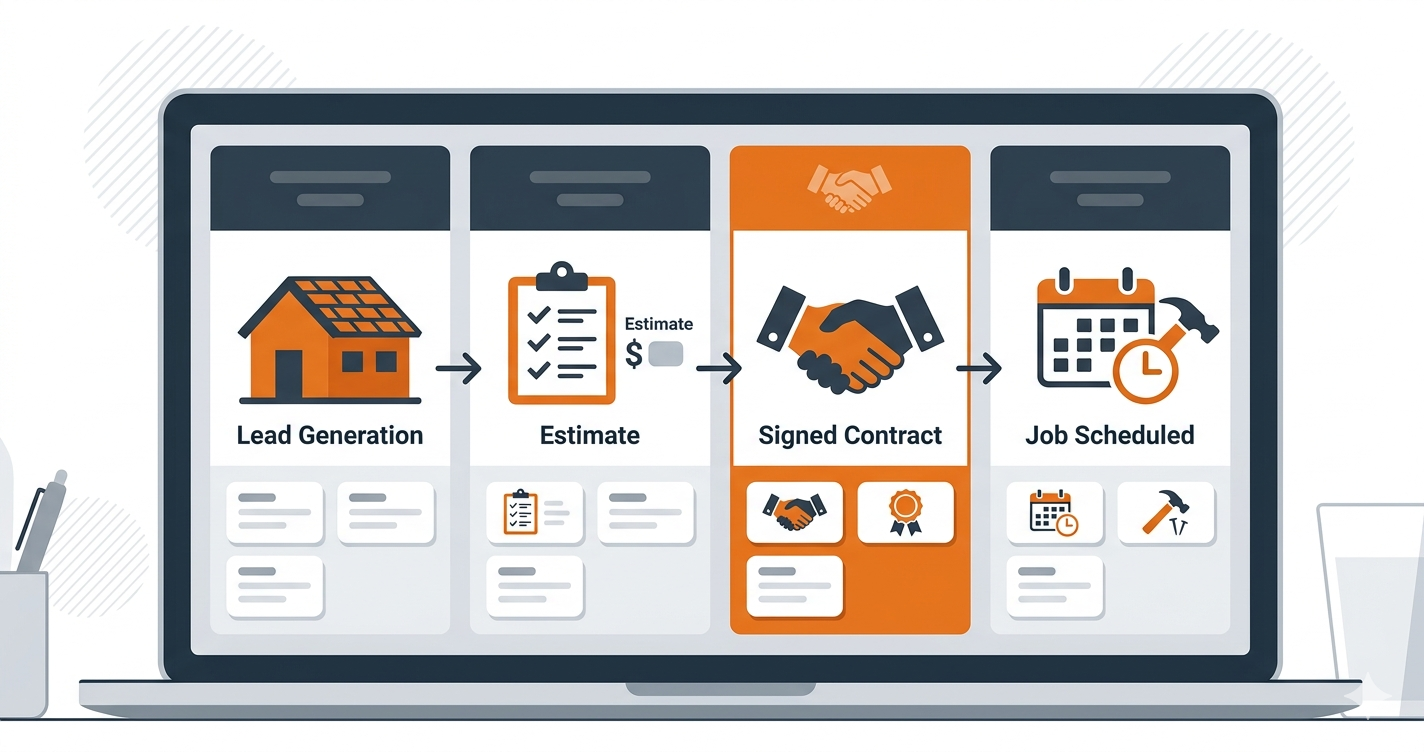
A visual board for every inspection and estimate, activity reminders for each follow-up touch, and alerts on any quote that has gone quiet. Built for trades that win work through quotes.
Why roofing pipelines behave differently from other trades
Three things make roofing distinct. Deal values are high — $8,000–$25,000 for a residential replacement — so a single lost lead is expensive in a way most home services aren’t. The decision timeline runs 2–4 weeks, with homeowners typically comparing two or three quotes along the way. And insurance jobs run an entirely separate track, since the real decision-maker on scope and payment isn’t the homeowner — it’s the adjuster.
Layer weather on top of that. A single storm event can generate 50–200 leads in 48 hours, and without a real system most of that spike is simply wasted — contacted too late, forgotten in an inbox, never followed up at all.
The seven stages worth tracking
| Stage | Meaning | Key action |
|---|---|---|
| 1. New lead | Enquiry received, not yet contacted | Auto-SMS within 5 minutes |
| 2. Contacted | Spoke or messaged, inspection not booked | Book inspection date |
| 3. Inspection scheduled | Date confirmed, not yet completed | Confirmation + reminder |
| 4. Estimate sent | Quote delivered, awaiting decision | Begin follow-up sequence |
| 5. Follow-up active | Actively nurturing the decision | Automated touches at D2, D5, D10, D21 |
| 6. Contract signed | Job won, production scheduling | Trigger production workflow |
| 7. Job complete | Work finished, invoice sent | Request review + referral |
Most companies have stages 1 and 6 under control — they respond to new leads and they know how to close a signed deal. It’s stages 4 and 5, the estimate follow-up window, where 30–40% of revenue quietly disappears.
Stages 1–3: winning the inspection
The longer a new lead waits, the harder it is to reach. After a storm, homeowners are often calling three or four roofers at once, and whoever gets on the roof first has a real head start on the job.
- Auto-SMS within 5 minutes: “Hi [Name], we just received your roofing inquiry and will call you within 15 minutes. Book an inspection time now: [link]”
- Immediate alert to the nearest available rep
- No answer at 15 minutes → second SMS with a direct booking link
- No response at 2 hours → follow-up email with credentials, project photos, and a booking link
- Lead moves to “Contacted” automatically once a call or reply is logged
Stages 4–5: the follow-up sequence that actually wins jobs
Most roofing companies send one estimate and call once, if at all. That doesn’t reflect how homeowners actually decide — they’re comparing quotes, they’re busy, and a $15,000 decision genuinely takes a couple of weeks to settle in someone’s mind. Steady, non-pushy follow-up is often the difference between winning the job and losing it to the roofer who called back.
- Day 2: “Hi [Name], just checking you received our estimate. Happy to answer any questions about materials, timeline, or warranty. Reply here or call us on [number].”
- Day 5: email with three recent project photos, a testimonial, and a short FAQ — subject line: “What to expect from your [Company] roof replacement”
- Day 10: “Hi [Name], we have availability in [month] and are starting to schedule. We can hold your spot this week if you’d like to lock in your date.”
- Day 21: “[Name], our estimate is valid for 30 days. Is there anything I can clarify? No pressure either way.”
Run the maths with your own numbers. On 20 estimates a month at a $12,000 average, signing just two more is $24,000 of work from leads you’d already paid to generate.
Ready to stop losing roofing quotes?
If several reps run inspections, Zoho CRM can start the follow-up automatically when a deal reaches “Estimate sent” and report close rates by rep and lead source. Free edition for up to 3 users; workflow automation on paid editions.
Insurance jobs need a second, parallel track
The decision-maker on an insurance restoration job isn’t the homeowner, it’s the adjuster — which means the pipeline needs a different set of stages:
- Storm inspection completed — damage documented, claim recommended
- Claim filed — submitted, adjuster meeting to be confirmed
- Adjuster meeting scheduled
- Claim approved — coverage confirmed, scope agreed
- Supplement filed — additional line items requested
- Supplement approved / contract signed — full scope confirmed, production scheduled
- Job complete / invoice to insurance
Each stage needs its own reminder — insurance jobs that sit idle for too long lose momentum, and sometimes the homeowner along with it. A good rule of thumb: nothing should sit longer than 7–10 days without a check-in.
Tools built for this
Pipedrive maps directly onto the seven stages above. Each inspection and estimate is a card on the board, activity reminders schedule every follow-up touch, and deal rotting flags quotes that have gone quiet, which is exactly where roofing revenue leaks. You can run a second pipeline for insurance jobs. Fits: owner-led and small sales teams. Not for: companies that need supplement tracking and production management in the same tool.
Zoho CRM suits companies with several reps and several lead sources. Workflow rules can start follow-up when a stage changes, assignment rules route storm leads to the nearest rep, and reports show close rates by rep, source and job type. Not for: an owner who wants to be set up in an afternoon.
Roofing-specific software such as AccuLynx and JobNimbus combines sales, insurance claims, supplements and production. Once insurance restoration is most of your work, they’re worth a look. We don’t have a partnership with either; we mention them because they may be the better fit.
Handling a storm event without losing the surge
- A pre-built storm campaign ready to fire to past customers in affected zip codes: “We know [city] was hit hard last night. We’re offering free storm damage inspections this week — book yours before slots fill: [link]”
- A dedicated storm pipeline stage so those leads are tagged and prioritised separately
- Accelerated follow-up — 24h and 48h touches, not the standard D2/D5 cadence
- Live capacity tracking so booked vs. available inspection slots is always visible, avoiding over-commitment
- Any inspection that finds storm damage auto-creates an entry on the insurance track
Don’t stop at the finished roof
Stage 7 is where most companies leave money sitting on the table. A completed job is the highest-leverage moment for reviews, referrals, and setting up the next touchpoint a year out — and none of it should require someone remembering to do it manually.
- Day 1 after completion: “Your new roof is done! A quick Google review means everything to us: [link]. Thank you — [Team]”
- Day 7: “Know any neighbours who might need their roof checked? We offer [referral incentive] for every introduction that leads to a job.”
- Month 11: “Your roof is coming up on its 1-year anniversary. Book your free annual inspection here: [link]”
What this is worth
These are worked examples, not promises. Swap in your own numbers.
- Estimate follow-up: on 20 estimates a month at $12,000, moving the close rate from 20% to 30% is two more jobs, or $24,000 a month.
- Storm response: if a storm brings 50 leads and a fast routine books 10 more inspections than you would have managed by hand, even a modest close rate adds several jobs.
- Referrals and repeat work: one extra referred job a month at $10,000 is $120,000 a year from a text you send automatically after each job.
- Past customers: an annual inspection reminder to 500 past customers keeps you first in line for repairs and eventual replacement.
Compare our top CRM picks
Zoho CRM
Free edition for 3 users. Multi-rep routing, workflows and reporting. Workflows on paid editions.
Frequently asked questions
What’s the single most important stage?
Estimate follow-up. It’s where most roofing companies leave the most money on the table — a four-touch sequence over 21 days wins back jobs that would otherwise go to whoever followed up.
How do you run insurance and cash jobs in the same system?
Two parallel pipeline tracks. Tag insurance jobs at the inspection stage and route them into the insurance-specific pipeline; cash jobs follow the standard 7 stages. Pipedrive and Zoho CRM both support separate pipelines; roofing-specific tools such as AccuLynx build the insurance track in.
How many stages should the pipeline actually have?
Seven works well for most roofing companies — enough detail to see where leads stall without so many stages that reps stop bothering to update them. A simpler pipeline people actually use beats a detailed one that gets abandoned.
The bottom line
The gap between a roofing company that closes a fifth of its estimates and one that closes a third is rarely better salespeople. It’s a better system underneath them. Structured pipeline management with automated follow-up, clear stage progression, and post-job re-engagement turns the same lead volume into meaningfully more revenue.
For CRM platform comparisons, see the best CRM for roofers. For broader tooling, see CRM integrations for service businesses.