How to Create and Sell a Maintenance Plan for Your Service Business
A one-off job pays once. A maintenance plan pays every month or year, fills your quiet weeks with scheduled work and keeps customers from calling a competitor next time.
HVAC, pest control, pool, lawn care, cleaning and plumbing businesses use plans to smooth out seasonal swings. The hard part isn’t designing the plan; it’s remembering to offer it, scheduling the visits and handling renewals. That’s where most plans quietly fail. This guide covers how to sell maintenance plans from start to finish: what to include, how to price it, what to say, and how to keep members renewing.
Take recurring plan payments for free
Systeme.io handles subscriptions and payment plans through its own checkout, so monthly members pay automatically. Free for up to 2,000 contacts.
What to include
- Scheduled visits: the core of the plan, such as an annual service or quarterly treatment.
- Priority booking: plan members get seen first when it’s busy.
- A member discount on repairs or extra work.
- Reminders handled for them, so they never have to remember.
Keep it simple. One or two tiers are easier to explain and sell than four.
Package it so customers get it in five seconds
Customers don’t buy a list of features; they buy not having to worry. Give each tier a plain name and a one-line promise. Here’s an illustrative two-tier layout for a heating business:
| Essential | Priority | |
|---|---|---|
| Annual service | Yes | Yes |
| Reminder and booking handled | Yes | Yes |
| Priority call-outs | No | Yes |
| Discount on repairs | No | Yes |
| Example price | [price] a month | [price] a month |
Two tiers give people a choice without a decision headache. Some will pick the higher one once they see what it adds. Part of how to sell maintenance plans is making the comparison easy, so nobody has to ask what’s different.
Pricing it
Price is where owners get nervous about how to sell maintenance plans. Work it out once, properly, and the conversation with customers gets much easier.
- Work out the cost of the included visits: time, travel and materials.
- Add the value of priority booking and the discount you’re offering.
- Price it so the customer saves a little compared with booking separately, while you gain predictability.
- Offer monthly payments as well as annual. Smaller monthly amounts are often easier to say yes to.
Plans work best when they’re profitable on their own, not just a discount that loses money.
A worked pricing example
These numbers are for illustration only; use your own costs. Say a pest control visit costs you about 50 in time, travel and materials, and you’d normally charge 90 for a one-off visit.
- Four quarterly visits, booked separately: 360 a year to the customer.
- Your cost for four visits: about 200.
- Plan price: 300 a year, or 25 a month. The customer saves 60; you keep around 100 margin and gain four guaranteed bookings.
- The hidden gain: route planning gets easier, and plan members call you, not a competitor, when something new appears.
Run the same sums for your own trade before you talk to a single customer. Knowing how to sell maintenance plans starts with knowing the plan makes money.
What to say at the end of a job
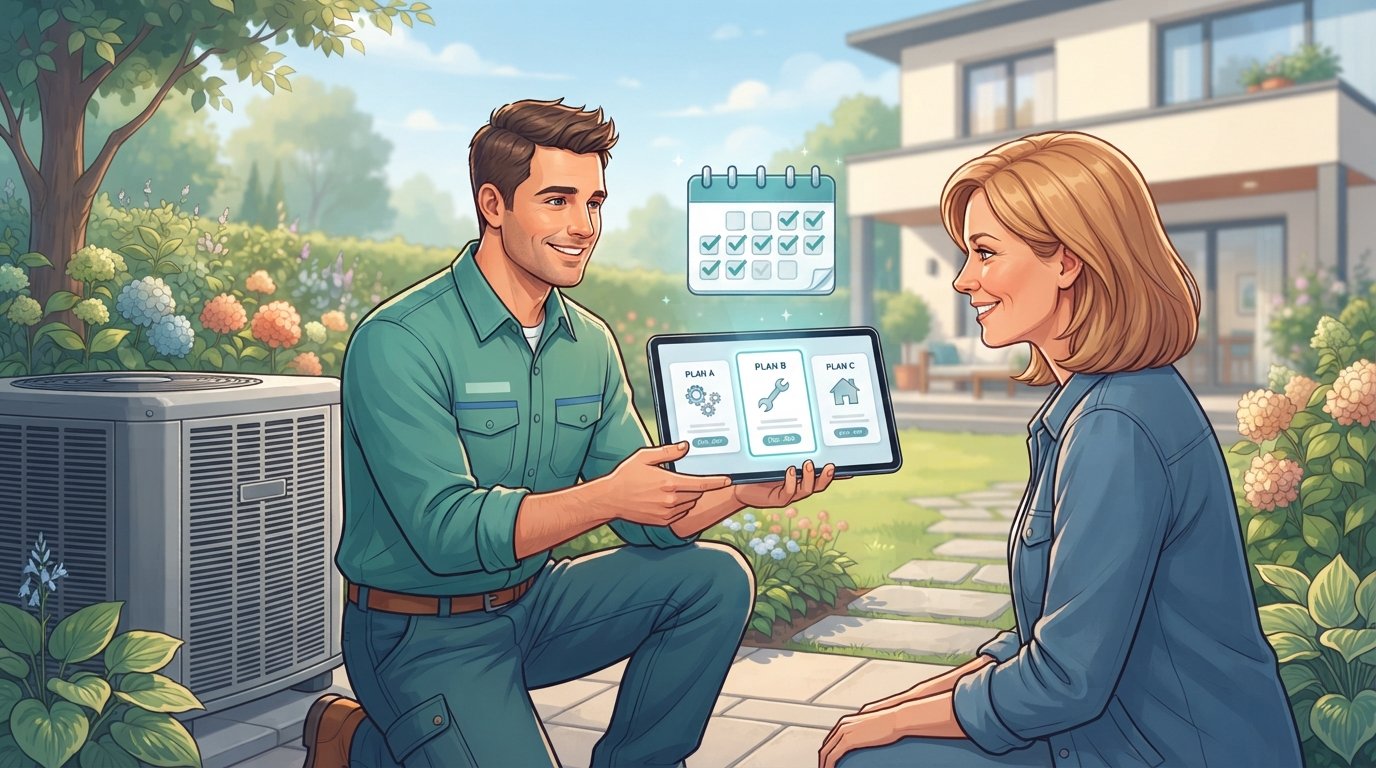
“Everything’s running well now. Most of our customers go on our maintenance plan so they don’t have to think about it. We book the next service automatically, you get priority if anything breaks, and [discount] on repairs. It’s [price] a month. Would you like me to set that up?”
The end of a successful job, when the customer has just seen your work, is the best moment to offer it. A follow-up email the next day works as a backup. If you’re learning how to sell maintenance plans, practise this one script until it sounds like you.
The next-day follow-up email
Subject: Your next service, sorted
“Hi [Name], thanks for having us round yesterday. As mentioned, our [plan name] covers your [annual service], books it for you automatically, and gives you priority if anything goes wrong. It’s [price] a month and you can sign up here: [link]. Any questions, just reply.”
When they say “I’ll think about it”
“Of course. I’ll send the details over so you have them. The main thing most people like is not having to remember the service, because we just get in touch when it’s due.”
Then send the email and set a single follow-up task for a week later. Don’t push harder than that.
When they ask “Is it worth it?”
“If you’d book the service anyway, it works out a little cheaper and you get priority and the repair discount on top. If you’d rather book as you go, that’s completely fine too.”
Being honest about who it doesn’t suit builds more trust than a hard close. That honesty is a big part of how to sell maintenance plans that people actually keep.
Track every plan member and renewal date
Zoho CRM keeps plan status, visit history and renewal dates on each customer record. Free edition for up to 3 users; workflow automation for scheduled reminders is on paid editions.
Running the plan
| Stage | What happens |
|---|---|
| Sign-up | Plan tag on the customer record; payment set up |
| Before each visit | Automatic reminder to book or confirm |
| After each visit | Summary of the work done and any recommendations |
| Before renewal | Reminder 30 days out, with what they received this year |
| If a payment fails | Friendly message with an updated payment link |
The renewal reminder is the most important step. Showing customers what they received during the year makes renewing an easy decision. For the wider approach, see building recurring revenue.
A plan that’s easy to run is easier to sell, because you’ll offer it with confidence. Running the plan well is the other half of how to sell maintenance plans.
Selling plans in different trades
Heating, cooling and plumbing
The annual service is the natural anchor. Offer the plan at every service and repair visit, and run a short campaign before the busy season to past customers who aren’t members. Here, how to sell maintenance plans mostly comes down to the peace of mind of priority call-outs.
Pest control, lawns, pools and gutters
Work is seasonal and repeats on a calendar, so sell the schedule itself: “we’ll be there every quarter, you don’t have to book”. Spring and early summer are good times to promote plans, when the problem is on people’s minds.
Cleaning and appointment businesses
Regular clients already behave like plan members. Turn the habit into a membership with a set number of visits a month, a fixed price and a perk such as a preferred time slot. For appointment businesses, how to sell maintenance plans is often just naming what loyal clients already do.
Pitfalls that sink maintenance plans
- Offering it only now and then. If the offer depends on who’s on site that day, take-up will be patchy. Make it part of every job close.
- Too many tiers or extras. Every option adds a question. Two tiers is plenty for most small firms.
- Underpricing to win sign-ups. A plan that loses money gets worse the more you sell.
- Missing visits. Nothing kills renewals faster than a member who had to chase you for the service they paid for.
- Silent renewals. Renewing without a reminder or a summary of the year invites cancellations and complaints.
- No owner. Someone has to be responsible for plan scheduling and renewals, even if a system does most of it.
Avoiding these is as important as the pitch. Most advice on how to sell maintenance plans focuses on the sale, but lapsed members cost you just as much.
Never miss a plan offer or renewal conversation
Pipedrive gives you a pipeline for plan offers and renewals, with a follow-up activity on each one so no customer slips through. From about $14/user, with a free trial.
Know whether your plans are working
Check these once a month. They’ll tell you whether to change the offer, the price or the way your team asks.
- Offer rate: of completed jobs, how many customers were offered the plan? This should be close to all of them.
- Take-up rate: of those offered, how many joined? If it’s low, look at the script and the price.
- Visits completed on time: late visits are an early warning for poor renewals.
- Renewal rate: of plans due, how many renewed? This is the number that decides whether plans pay off.
Measuring these four numbers turns how to sell maintenance plans from guesswork into something you can improve each month.
Terms, cancellations and consent
Plans involve recurring payments and ongoing messages, so be clear and fair from day one.
- Write simple terms: what’s included, how payments work, how to cancel and what happens to visits already paid for.
- Be upfront about renewals. If a plan renews automatically, say so at sign-up and remind people before it does. Rules on automatic renewals vary, so check what applies where you operate.
- Respect marketing consent. Reminders about a service someone has paid for are different from promotional emails. For promotions, follow the email rules that apply to you; in the US, the FTC’s CAN-SPAM compliance guide is a clear starting point.
Fair terms are part of how to sell maintenance plans with a clear conscience, and they reduce disputes later.
Which tool should run your plans
A spreadsheet can track a dozen members. Beyond that, you’ll want software to handle reminders, payments and renewal dates.
- Systeme.io: strong for taking monthly subscription payments and sending member emails. Not for: scheduling technician visits or managing jobs.
- Zoho CRM: strong for tracking plan members, visit history and renewal dates on each customer. Not for: anyone who needs automated renewal reminders but plans to stay on the free edition.
- Pipedrive: strong for making sure every plan offer and renewal gets a follow-up. Not for: businesses that want built-in recurring billing.
Pick the one that fills your biggest gap, whether that’s payments, records or follow-up. With the right tool, how to sell maintenance plans becomes a routine rather than a reminder on a sticky note.
For pricing and cash-flow planning, the U.S. Small Business Administration’s guide to managing your business is a useful free reference.
Frequently asked questions
Which businesses suit maintenance plans?
Anything with regular, predictable upkeep: heating and cooling, pest control, pools, lawns, gutters, cleaning, water treatment and similar. If customers already rebook you on a cycle, learning how to sell maintenance plans is worth the effort.
Monthly or annual payment?
Offer both. Monthly lowers the barrier; annual improves cash flow and reduces admin. Offering both is one of the easiest wins in how to sell maintenance plans, because it removes a common objection.
How do I stop plans lapsing?
Automate visit reminders and renewal notices, and remind customers what they’ve received. Keeping members is the quieter half of how to sell maintenance plans.
When is the best time to offer a maintenance plan?
At the end of a successful job, while the customer can see the result. A short follow-up email the next day catches anyone who wanted time to think. Timing is the first thing to get right when working out how to sell maintenance plans.
How much should a maintenance plan cost?
Start from your cost of delivering the included visits, add a fair margin, and price it a little below booking the same visits separately. Then check it still makes money if every member uses every benefit.
Should technicians earn commission on plan sales?
A small reward can help, but keep it modest so the offer never feels pushy. Training and a good script usually matter more than the incentive. How to sell maintenance plans well is about trust, not pressure.
Can I offer a plan to customers I’ve already served?
Yes. Past customers who already trust you are often the easiest sign-ups. Send a short, personal message before their next service is due, with the plan details and a sign-up link. Only contact people who’ve agreed to hear from you.
Compare our top picks
Systeme.io
Free up to 2,000 contacts. Subscriptions and payment plans through its own checkout.
Zoho CRM
Free edition for up to 3 users. Plan tracking and renewal workflows on paid editions.
Related guides
Affiliate Disclosure: This article contains affiliate links. If you sign up through them we may earn a commission at no extra cost to you. It never decides which tool we recommend. See how we test and recommend tools.