
GoHighLevel for Service Businesses: The Ultimate Honest Review (2026)
Is GoHighLevel for service businesses actually worth $97/month in 2026, or is it over-engineered for most local operators? The platform has become one of the most searched CRM topics among contractors, HVAC companies, cleaning businesses, and local service operators. It promises to replace five or more separate tools — CRM, SMS automation, funnels, reputation management, and appointment booking — in one subscription. This ultimate honest review of GoHighLevel for service businesses covers real features, real limitations, and realistic cost expectations so you can make the right call.
What Is GoHighLevel?
GoHighLevel is an all-in-one marketing and automation platform originally built for digital marketing agencies but now widely adopted by field service companies, contractors, and local businesses. It combines CRM, email marketing, SMS automation, funnel building, appointment booking, reputation management, and AI conversation automation in one monthly subscription. The core appeal of GoHighLevel for service businesses is consolidation — instead of paying separately for a CRM, an email tool, an SMS platform, and a review management system, it replaces all of them at $97/month. For businesses currently spending $200–$500/month across multiple tools, this consolidation alone can justify switching.
7 Core Features That Make GoHighLevel for Service Businesses Stand Out
1. Missed Call Text-Back Automation
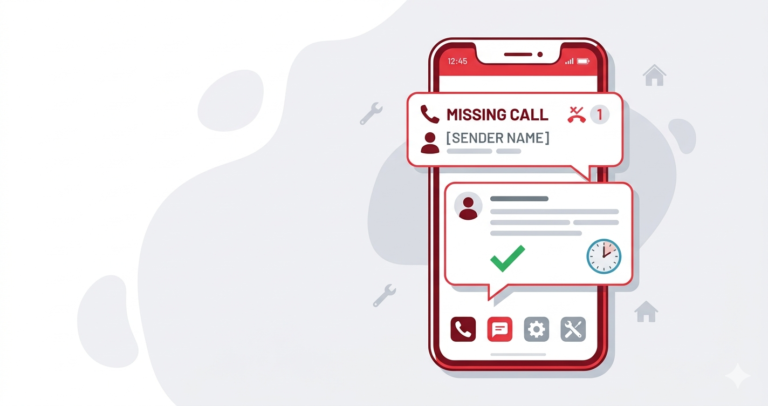
This is the feature that converts most service business owners to GoHighLevel for service businesses. Every time someone calls and the call goes unanswered, the platform automatically sends an SMS within seconds. For a full breakdown of how to set this up, see our guide on CRM missed call automation. At $300 average job value and 5 missed calls recovered per month, it covers the entire subscription cost. For HVAC, plumbing, and electrical businesses missing 20–40% of inbound calls because crews are out on jobs, this feature alone makes the platform worth the investment.
2. Lead Follow-Up Automation
When a lead arrives from your website, Google, or Facebook ads, the system immediately sends a text and email, follows up at day 1, 3, 7, and 14, and moves the lead through pipeline stages automatically based on responses. This systematic follow-up converts 25–40% more leads than manual processes where someone calls once and gives up. For a landscaping company with 30 monthly leads at $400 average job value, even a 15% improvement in conversion equals $1,800 in additional monthly revenue from the same lead volume.
3. Reputation Management
Automated Google review requests fire after every completed job — immediately after payment when customer satisfaction peaks. Businesses using this feature accumulate Google reviews 4–6x faster than competitors requesting manually, directly improving local search rankings. More reviews mean better positioning in Google Maps, which generates more inbound enquiries at zero additional ad spend. Over 6–12 months, this creates a compounding competitive advantage.
4. Sales Pipeline and CRM
A visual pipeline shows every lead at each stage: new enquiry, quote sent, follow-up needed, booked, completed, and review requested. Most service businesses operate without this visibility entirely — adding it gives owners a clear picture of where revenue is coming from, where leads are getting stuck, and which follow-up sequences are producing results. Pipeline visibility alone often reveals $5,000–15,000 in monthly revenue leakage from leads that never received follow-up.
5. SMS and Email Campaign Automation
Bulk SMS and email campaigns go out to your entire customer database. Seasonal campaigns — spring startup offers, pre-winter service reminders, annual maintenance outreach — send automatically to segmented customer lists at the right time of year. Businesses with 500+ past customers consistently generate $10,000–30,000 in additional annual revenue from seasonal campaigns alone. The ability to segment by service type, location, and recency makes these campaigns highly targeted.
6. Funnel and Landing Page Builder
For businesses running paid Google or Facebook ads, the drag-and-drop funnel builder creates high-converting dedicated landing pages. Instead of sending ad traffic to a generic website homepage, leads land on a service-specific page that captures enquiries directly into the CRM pipeline. This single change typically improves paid ad conversion rates by 20–40% — making the same ad budget produce significantly more booked jobs.
7. AI Conversation Automation
AI-powered conversation bots respond to leads 24/7 — answering questions, qualifying leads, and booking appointments automatically when no one is available. This is particularly transformative for businesses that generate enquiries outside business hours. For a complete after-hours lead strategy, see our guide on after hours lead response CRM. The AI handles the initial conversation and routes qualified leads to the business owner or team for follow-up.
💡 Want powerful automation without the steep learning curve?
Systeme.io delivers email automation, funnels, and lead nurturing at $27/month — ideal for service businesses that don’t need the full complexity of GoHighLevel.
Pricing Breakdown (2026)
- Starter — $97/month: 1 location, full CRM, SMS and email automation, funnels, pipelines, reputation management, and AI conversation. Everything a single-location service business needs.
- Unlimited — $297/month: Unlimited sub-accounts and white-label capability. Designed for marketing agencies managing multiple service business clients.
- Agency Pro — $497/month: SaaS mode for agencies wanting to resell the platform under their own brand with custom pricing.
Important: SMS sends are billed separately through the LC Phone system at approximately $10–25/month for typical service business usage volumes. Factor this into your comparison. Realistic all-in monthly cost for a single-location operation running GoHighLevel for service businesses: $110–$147/month.
Where the Platform Excels
Missed call text-back is genuinely unmatched. No competing platform at any price point delivers the same seamless missed call recovery automation out of the box. For inbound call-dependent service businesses — HVAC, plumbing, electrical, cleaning — this single feature consistently delivers the highest ROI of any automation available.
Unified inbox consolidates SMS, email, Facebook Messenger, Instagram DM, and Google Business Messages into one screen. For businesses currently managing customer conversations across four different apps, this saves an hour daily and prevents leads from falling between channels.
All-in-one consolidation genuinely reduces software costs for businesses currently paying separately for CRM, SMS, email marketing, and review management tools. The math often works in GoHighLevel’s favour for businesses already spending $150+/month across multiple platforms.
Where It Falls Short
No field scheduling or route optimization. There is no crew scheduling calendar, job dispatching, route optimization, or technician mobile app. Service businesses with multiple crews managing complex daily job schedules need a separate platform like Jobber or HouseCall Pro for operational management. This is the most significant gap for trades businesses evaluating GoHighLevel for service businesses.
Steep learning curve. Setup typically takes 10–20 hours for a single-location service business. Owners who want something working out of the box in one hour will struggle — and many abandon setup partway through without agency support. This is a meaningful barrier for non-technical business owners.
SMS usage costs add up. Unlike Systeme.io which includes unlimited email sends at $27/month, GoHighLevel bills SMS separately. Active businesses sending appointment reminders, follow-ups, and review requests can accumulate $30–50/month in messaging costs on top of the base subscription.
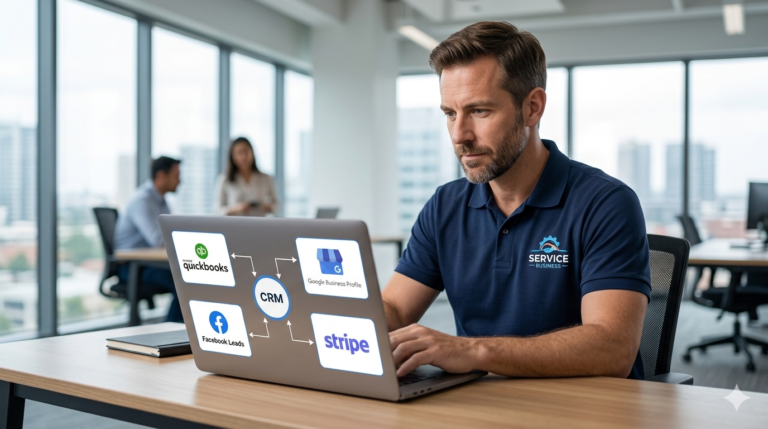
No native invoicing or QuickBooks integration. The invoicing is basic and accounting integrations require Zapier workarounds, making the platform unsuitable as an operational replacement for Jobber or HouseCall Pro’s invoicing and payment collection features.
GoHighLevel vs Systeme.io: Which Is Better Value?
- GoHighLevel for service businesses — $97/month + SMS costs: Powerful SMS automation, missed call text-back, unified multi-channel inbox, AI conversation bots. Higher complexity and setup time. Best for high-volume inbound call businesses and paid ad campaigns.
- Systeme.io — $27/month, unlimited emails: Email automation, lead nurturing, past customer campaigns, funnels, and program delivery. Simpler setup. Delivers the core marketing automation most service businesses actually need at 28% of the cost.
For service businesses that primarily need email-based customer marketing, past customer re-engagement, and lead nurture sequences, Systeme.io delivers 80% of the revenue impact of GoHighLevel for service businesses at a fraction of the monthly cost. The decision comes down to whether SMS automation and missed call text-back are essential for your operation.
🚀 Start automating your service business today — free
Systeme.io is the budget-friendly alternative — email sequences, funnels, and CRM pipelines with zero monthly fees to start.
Real ROI Scenarios
HVAC company missing 8 calls daily: Missed call text-back recovering 30% = 2.4 additional bookings daily at $250 average = $180,000 in annual revenue recovered. The $147/month all-in cost is trivial against that return.
Landscaping company running Facebook ads: Instant SMS response improving lead conversion from 12% to 28% on 40 monthly leads at $400 average = $2,560 additional monthly revenue from the same ad spend. The platform pays for itself within the first week of each month.
Cleaning company with 400 past customers: Seasonal SMS campaign converting at 18% = 72 additional cleanings at $150 average = $10,800 from one campaign send. The platform pays for itself 73x over from one message blast to a properly maintained customer database. These numbers are why GoHighLevel for service businesses with an established customer base is such a compelling investment.
Who Should Use GoHighLevel for Service Businesses
GoHighLevel for service businesses makes sense when you are:
- Missing 20%+ of inbound calls and need missed call text-back running 24/7
- Running paid ads on Google or Facebook and need funnels and a CRM pipeline to convert leads properly
- Currently paying for 3+ separate tools that can be consolidated into one platform
- Wanting AI-powered 24/7 lead response without hiring additional staff
- Managing multiple service business locations and need sub-account management
GoHighLevel for service businesses does not make sense when crew scheduling and field management are your primary operational need, you generate fewer than 20 inbound leads per month where the automation ROI doesn’t justify the cost, or you want something fast and simple to set up without technical knowledge or agency support.
Pipedrive: The Visual Pipeline Alternative for Sales-Focused Service Businesses
If GoHighLevel feels like overkill but you still need a dedicated CRM with strong pipeline visibility, Pipedrive is worth serious consideration. Built around a drag-and-drop visual pipeline, Pipedrive gives service businesses instant clarity over every lead, quote, and follow-up in progress — without the learning curve of an all-in-one marketing platform. At $14/user/month, it’s one of the most affordable visual CRMs available and integrates cleanly with most quoting, scheduling, and invoicing tools already in your stack.
Where Pipedrive shines for service businesses is in deal management and follow-up accountability. Its activity reminders and deal rotting alerts flag stale leads so nothing gets forgotten, and the mobile app is genuinely strong for owner-operators who need CRM access in the field. For businesses that don’t need GoHighLevel’s full SMS automation suite but do want a proper visual sales pipeline, Pipedrive sits in a very practical sweet spot.
🔧 Pipedrive: The visual CRM built for closing deals
Pipedrive’s drag-and-drop pipeline gives you instant visibility over every lead, quote, and follow-up — so nothing slips through the cracks. From $14/user/month.
Frequently Asked Questions
Is GoHighLevel good for service businesses?
Yes — GoHighLevel for service businesses is excellent for marketing automation, lead follow-up, missed call recovery, and reputation management. It is not a field service management platform. Most companies get the best results using it alongside a field service platform like Jobber rather than as a standalone replacement for operational scheduling tools.
How much does it cost?
The Starter plan is $97/month but realistic all-in costs for GoHighLevel for service businesses range from $110–$150/month once SMS usage is included. Compare this to Systeme.io at $27/month with unlimited emails for service businesses that primarily need email-based automation rather than SMS campaigns.
How long does setup take?
Initial setup typically takes 10–20 hours to configure pipelines, automation sequences, SMS templates, and funnel pages. Most owners either hire a GoHighLevel-certified agency for setup or follow structured onboarding programs available in the GoHighLevel community. It is not a same-day setup tool — plan for 1–2 weeks of configuration before the platform is fully operational.
Can it replace Jobber?
No. GoHighLevel for service businesses cannot replace Jobber’s field scheduling depth, route optimization, crew management, or operational invoicing. For service businesses with multiple crews, use GoHighLevel for marketing and Jobber for field operations — the combination outperforms either platform alone.
Is it better than HouseCall Pro?
They solve different problems. GoHighLevel for service businesses handles marketing automation, lead nurturing, and missed call recovery. HouseCall Pro handles field scheduling, online booking, and customer experience. Most growing service businesses benefit from using both — HouseCall Pro for operations and GoHighLevel for marketing — rather than choosing between them.
Final Verdict: Is GoHighLevel for Service Businesses Worth It?
The verdict on GoHighLevel for service businesses is clear: it is worth the investment when your primary pain points are lead follow-up, missed call recovery, paid ad conversion, or multi-tool consolidation. It delivers exceptional automation that genuinely transforms lead conversion for service companies losing revenue to slow or non-existent follow-up systems. If your primary need is field scheduling, operations management, or affordable email marketing, Systeme.io at $27/month, Jobber, or HouseCall Pro each serve you better.
📈 Not ready for GoHighLevel’s complexity? Start with Systeme.io
Get email automation, funnels, and a CRM pipeline free — then upgrade when your volume demands it. 300,000+ businesses already use it.
Explore more service business CRM guides: Jobber vs HouseCall Pro vs GoHighLevel, CRM with automated text messaging, CRM for appointment reminders, CRM for Google Local Service Ads, and CRM integrations for service businesses.
Compare Our Top CRM Picks
Related Articles
- CRM Missed Call Automation: How to Recover Lost Leads Instantly (2026)
- After Hours Lead Response CRM: Stop Losing Leads When Your Office Is Closed (2026)
- 8 CRM Automations for Contractors That Save 10+ Hours Every Week (2026)
- Best CRM for One Person Business: Top Tools for Solo Service Operators (2026)
- Best CRM Integrations for Service Businesses: The Ultimate Guide (2026)
Affiliate Disclosure: This article contains affiliate links. If you click through and make a purchase, we may earn a commission at no additional cost to you. We only recommend products we believe add real value to our readers.